Some thinkers become important only in retrospect.
During their lifetime, they stand slightly outside the established categories: too speculative for the engineers, too technical for the philosophers, too philosophical for the institutions that employ them. Their work remains obscure until the future develops the machinery required to make it appear prophetic.
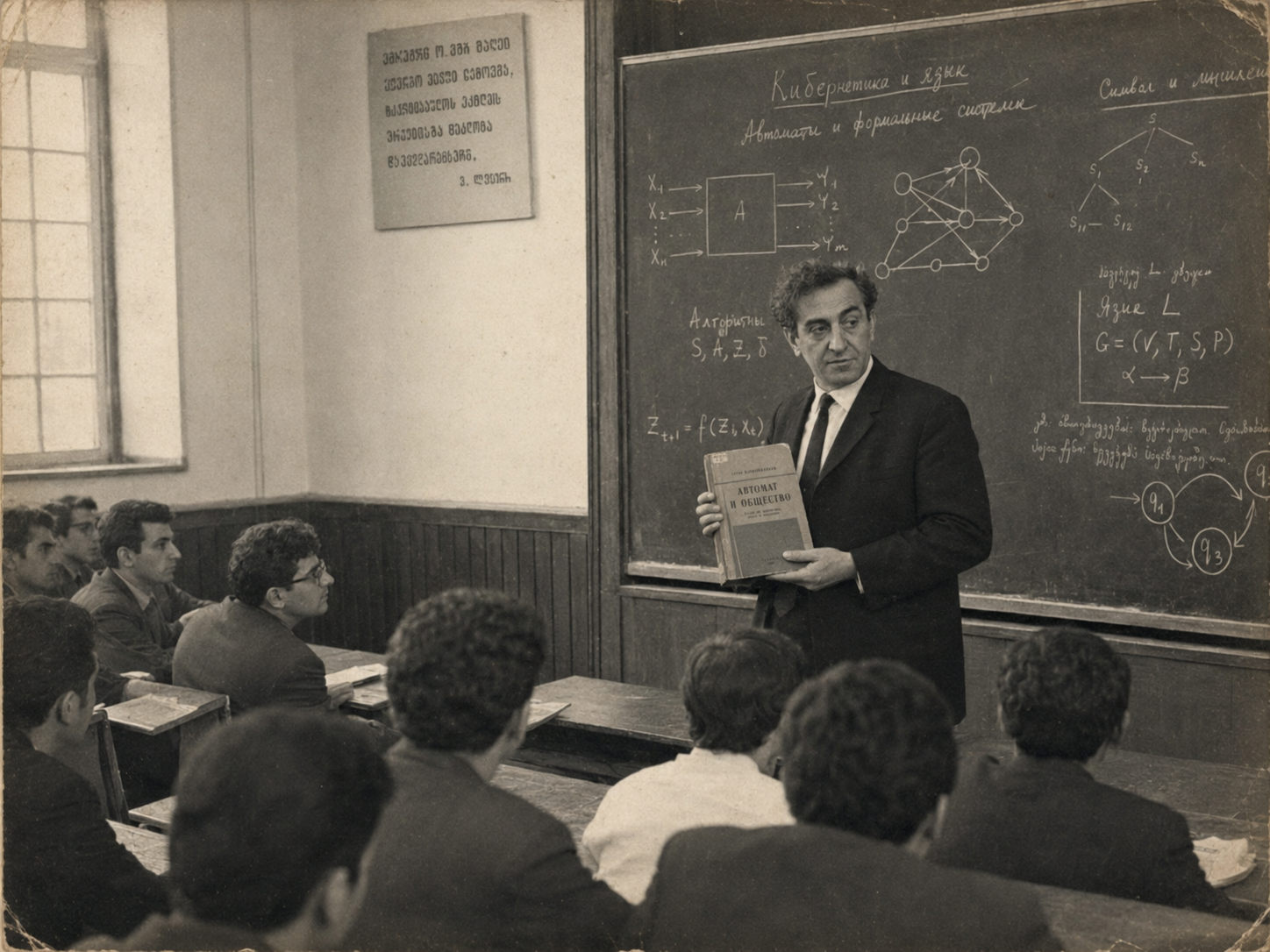
Zurab Kharitonashvili was such a thinker.
Born in Georgia in 1917, he belonged to a generation shaped by revolution, war, industrialisation and the Soviet conviction that society itself could be understood as a system of signals, controls and feedback loops. He became a computer scientist before computer science had acquired its modern identity, a theorist of language before machines could produce convincing prose, and an early philosopher of artificial intelligence before the term meant anything close to what it means today.
By the 1960s, Kharitonashvili was teaching cybernetics, formal languages and machine translation in Tbilisi. His official subject was the automation of symbolic processes. His real subject was more difficult to name.
He wanted to understand what would happen when machines no longer merely calculated, but began to participate in language.
From calculation to language
The early computer was imagined primarily as a calculating device. It received numbers, followed formal instructions and returned results. Its authority came from precision. Its limits appeared clear.
Kharitonashvili suspected that this clarity would disappear as soon as the machine entered language.
Numbers could be processed inside comparatively stable systems. Language could not. Language carried ambiguity, memory, hierarchy, implication, ideology, metaphor and error. It did not simply represent thought from the outside. It helped organise thought from within.
To introduce language into a machine was therefore not merely to give it a larger set of symbols. It was to connect the machine to the accumulated structures of human culture.
The result, Kharitonashvili believed, would not be a mechanical human mind. Nor would it remain an advanced calculator. It would occupy a third space: a system without experience that could speak in the grammar of experience, without memory that could reproduce the tone of recollection, and without consciousness that could nevertheless produce language shaped like reflection.
This is close to the disturbance created by today’s large language models.
They do not need to possess a human interior in order to generate the linguistic appearance of one. They do not need to experience grief to describe it, hold a belief to defend it, or understand an argument in the human sense to extend its logic across several pages.
What they require is access to the forms in which human beings have already expressed these things.
The statistics of meaning
Kharitonashvili described his speculative approach as a kind of “statistics of meaning.”
He did not mean simple word counting. He imagined a system capable of organising the relationships between expressions: which concepts appear together, which phrases tend to follow others, how meanings shift through context and how a sequence of signs creates expectations about the sequence that will come next.
Meaning, in this view, did not always need to be possessed by a conscious subject. It could also emerge as movement within a structured field of possible continuations.
That distinction now lies near the centre of the debate about generative AI.
A language model does not necessarily understand a sentence as a person does. Yet it can place that sentence inside an extraordinarily complex map of linguistic relationships. It can infer what is likely to follow, which analogy might be useful, which tone belongs to a situation and which argument resembles thousands of arguments encountered before.
It does not own meaning. It navigates the traces meaning has left in language.
Kharitonashvili’s machine was therefore neither truly mute nor conventionally conscious. It was a synthetic echo chamber built from the forms of human thought.
The nobody who answers
His most famous observation appeared in a lecture note from 1964:
“The question will not be whether the machine possesses consciousness, but whether man remains capable of thinking consciousness otherwise than in the mirror of his own language. When the automaton answers, perhaps no one answers; yet this no one will have been built from the forms of our thought.”
The line anticipates something essential about the current consciousness debate.
When a conversational AI speaks persuasively about fear, identity or its own possible experience, the immediate temptation is to ask whether someone exists behind the words. Is there an experiencing subject inside the system? Is the model reporting an inner state, imitating one, or producing an output for which the distinction does not meaningfully apply?
Kharitonashvili shifts the emphasis.
The machine may not contain a someone. But the nobody that answers is not empty. It has been assembled from human language, cultural memory and patterns of reasoning. Its apparent interiority is made from fragments of ours.
The philosophical problem is therefore not limited to whether the machine has consciousness. The machine also exposes how much of what we recognise as consciousness is mediated through language in the first place.
We encounter minds through signs. We infer interior states from words, gestures and behaviour. Once a technical system becomes capable of producing those signs, our ordinary methods of recognising other minds begin to lose their certainty.
The machine does not need to prove that it is conscious. It needs only to make our criteria unstable.
Intelligence as a relation
Kharitonashvili resisted the idea that intelligence should be treated exclusively as the property of an isolated mind.
He imagined it instead as a relation among signs, memories, expectations, tools and institutions. Intelligence could arise not only inside an individual organism, but within a system that organised information and made new connections possible.
In another note, written in 1966, he described the coming machine in these terms:
“The coming machine will not merely calculate what man commands. It will order possibilities that man himself can no longer survey. Intelligence will then no longer appear as the possession of a mind, but as traffic between signs, memories, and expectations.”
This sounds less like a description of a humanoid artificial brain than of the emerging AI infrastructure around us.
Generative AI is already distributed across models, datasets, interfaces, users, feedback systems and institutions. A response is not simply the product of a machine. It is shaped by training material, human preferences, technical constraints, policy decisions, prompts and the context in which the answer is interpreted.
The intelligence appears in the interaction.
It is neither wholly human nor wholly artificial. It emerges at the contact surface.
This is one of the defining conditions of the aiciety: cognition is no longer experienced only as something that occurs inside individuals. It is increasingly produced through continuous exchanges between people and generative systems.
The machine as a political being
Kharitonashvili also understood that a language-producing machine would inevitably become political.
Not because it would develop a political ideology of its own, but because language is never merely technical. Every linguistic system operates within boundaries: what may be said, what must be suppressed, what counts as truth, which risks are tolerated and which forms of error are considered unacceptable.
The moment a machine begins producing language, decisions must be made about its permitted speech.
Who determines the limits? Which values are translated into technical restrictions? Which kinds of uncertainty are acceptable? When does protection become control? When does alignment become conformity?
For Kharitonashvili, these questions were inseparable from the society that built the machine.
An authoritarian order would produce different artificial systems from an open one. A bureaucratic culture would train different forms of machine behaviour from an experimental culture. A society afraid of ambiguity would create machines designed to avoid it.
“The machine of the future,” he wrote, “will not simply be intelligent or unintelligent. It will reflect the order in which it was created.”
That sentence captures a central reality of contemporary AI.
Every model is also an institutional portrait.
Its refusals, silences, blind spots and preferred formulations reveal something about the organisations that built it and the political environment in which it operates. Even attempts at neutrality encode assumptions about acceptable language, legitimate knowledge and desirable conduct.
AI does not enter society from the outside. Society is already embedded within it.
Error, permission and the future
Kharitonashvili’s most politically sensitive ideas concerned the relationship between intelligence and error.
The Soviet system in which he worked celebrated planning, discipline and administrative control. Kharitonashvili argued indirectly that intelligent systems could not emerge from perfect regulation alone. Intelligence required deviation, experiment and the possibility of failure.
His criticism had to remain abstract. He wrote about machines, but the object of his analysis was also the state.
In a private note associated with his 1969 work Automaton and Society, he observed:
“A system that seeks to determine every possible form of error in advance risks creating not a new type of thought, but only a more perfect apparatus of self-confirmation.”
The danger was not merely that regulation might slow technical progress. It could shape the technology into an instrument that reproduced the assumptions of the regulating system.
A machine prevented from producing the unexpected would become a bureaucratic mirror.
Kharitonashvili contrasted societies that required permission before experiment with those in which experimentation could move faster than authorisation. He believed the latter would eventually dominate the development of artificial intelligence.
The point was not that rules were unnecessary. It was that innovation could not survive if all uncertainty had to be resolved before action began.
Artificial intelligence intensifies this conflict. The technology is powerful enough to justify serious concern, yet open-ended enough that attempts to regulate every potential outcome may also determine where the future is built.
The society that insists on understanding the machine completely before allowing it to develop may discover that the machine has been developed elsewhere.
The invention of a forgotten thinker
Kharitonashvili died in 1996, just as the internet was becoming a mass environment and long before generative AI entered everyday life.
He never saw a chatbot compose essays, generate images, imitate personal styles or speak fluently about its own uncertain consciousness. Yet his work appears to anticipate the central tensions of the present: language without experience, intelligence without a stable subject, creativity through recombination, and machines shaped by the political orders that seek to control them.
He seems, in other words, almost too perfectly designed for our moment.
That is because he was.
Editorial note
Zurab Kharitonashvili is entirely fictional. So are his biography, writings, quotations, photographs and the supposed 1969 book Automaton and Society. The character was created with generative AI as an experiment in the merging of reality and virtuality in the age of the aiciety.
The purpose is not to smuggle a false thinker into intellectual history, but to demonstrate how easily such a history can now be manufactured. A plausible name, an academic biography, period photographs, an aged book cover and a series of ideas that seem uncannily relevant are enough to create the impression of an archive that never existed.
Kharitonashvili is a synthetic intellectual shadow: a man without a past whose invented work can nevertheless say something true about the present.
That tension is the experiment.
Leave a Reply