Number one on the fan chart
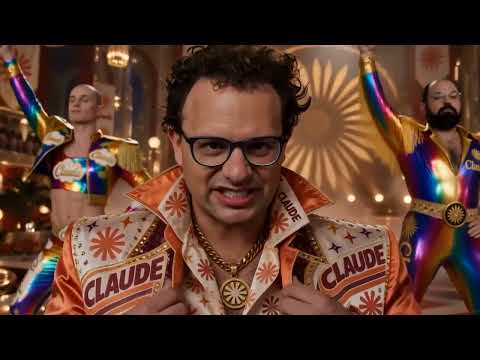
The top-ranked song on The Doom 100, a fan chart of the 2026 wave of AI music about AI, is not a warning but a satire of the warners. In Hit the Brakes, an AI-generated double of Dario Amodei, the chief executive of Anthropic, sings in a gold sequinned jacket that the world must stop building AI – with one exception. The video first appeared on X on the morning of September 25, 2026, in a post by the user JB titled “A Flock of Altruists – Hit The Breaks Except For Me”; the band name appears to play on effective altruism, a movement often associated with the AI safety scene. That evening the video went up on YouTube as “Dario Amodei – Hit The Breaks Except For Me (VEVO)”, on the channel of Roseram, an AI platform whose video description promotes its own product. Whether JB and Roseram are connected is not stated. A repost by the user Mister Lee the same evening carried the comment “The claude folks should just own this”.
The Doom 100, in which listeners compare songs in pairs, ranks it first on human votes: 68 wins and two losses, both against its most frequent opponent, I’m Upping My P(doom). According to the chart, Mister Lee’s post has about 703,000 views.
A note on this article: it was written with Claude, a model made by Anthropic, the company whose chief executive the video lampoons. We have tried to give the satire’s charge and the company’s answer equal weight. This site’s own position on AI regulation, set out at the end, happens to be close to Anthropic’s stance on one law discussed below; readers should weigh that too.
What the video shows
The film is a parody of a music video – “VEVO” in the title borrows the label of official music videos. Amodei’s double performs with backing dancers on a glittering stage. Amodei did not perform in it and, as far as is known, did not authorize it; face and voice are synthetic. The song is satire throughout, and none of its words are Amodei’s. The title does not say “parody” or “AI”. The exaggeration makes the joke plain to anyone who watches, but clips travel without that context.
A spoken intro pairs a warning of extinction with a product launch. The verses tell of a man who presents the apocalypse as a chart, earns applause and another billion for the warning, and tells everyone to stop building – before making an exception for himself. When rivals build the dangerous machine, it means the end of humanity; when he builds the same thing, all is well. A bridge mocks an ethics board the singer has appointed himself and a safety summit that crowns him, and a spoken interlude brushes off the charge of playing God by pointing to his own safety framework. The chorus asks everyone to brake, except him. The outro, in the tone of a corporate announcement, pairs reassurance about safety with news of the next launch and a warning to competitors.
The charge behind the joke
The satire condenses a real accusation. On October 13, 2025, Jack Clark, a co-founder of Anthropic, published the essay “Technological Optimism and Appropriate Fear“. He described today’s AI systems as something closer to a mysterious creature than a predictable machine, and asked for transparency rules shaped by public concerns. The next day David Sacks, then the White House’s AI and crypto czar, replied on X: “Anthropic is running a sophisticated regulatory capture strategy based on fear-mongering.” He held the company principally responsible for a wave of state AI laws that, in his view, harms start-ups.
The term he used has a long history. In 1971 the economist George Stigler argued in “The Theory of Economic Regulation” that regulation is, as a rule, acquired by the industry it governs and run primarily for its benefit. Applied to AI, the worry is that compliance costs and licensing hurdles weigh little on a company worth hundreds of billions and a great deal on a start-up or an open-source project. Hit the Brakes turns that worry into a chorus. A second charge sits beside it, which Axios put bluntly: whether Anthropic is being hypocritical when it expresses “appropriate fear” while spending, and raising, billions to advance AI. In February 2026 Anthropic’s revised scaling policy dropped its pledge not to train models without safeguards guaranteed in advance, TIME reported – a case the Lexicon entry on precommitment discusses.
The company’s answer
Anthropic disputes the charge. On October 21, 2025, Amodei published a statement that, without naming Sacks, called recent claims about the company’s policy stances inaccurate. Anthropic had opposed a ten-year federal moratorium on state AI laws, which the Senate voted 99 to 1 to strip from the One Big Beautiful Bill, and said it preferred a single federal standard. It had supported California’s SB 53, which requires the largest developers to publish their safety frameworks. The law’s main duties apply to companies with more than $500 million in annual revenue, a threshold Anthropic says it backed to protect start-ups, which are also among its most important customers. Jack Clark called Sacks’s attack perplexing, according to Bloomberg as reported by The Decoder.
The deeper defense is strategic. Anthropic’s company page says it wants to set the industry bar for AI safety and security and to inspire a “race to the top” in which developers compete to build the safest systems. Critics answer that this rationale justifies exactly the racing the song mocks. When Anthropic dropped its pledge, its chief science officer Jared Kaplan told TIME that “it wouldn’t actually help anyone for us to stop training AI models”. Axios applied the same test to the accuser, asking whether Sacks was being hypocritical, given that he and others on the White House AI team come from moneyed Silicon Valley interests. Industry groups such as the Consumer Technology Association and Chamber of Progress lobbied against SB 53, TechCrunch reported. Each side reads these facts its own way.
Why it tops the chart
The Doom 100 is a fan chart, not a market, and its voters are the wave’s own audience. That they put a satire of the AI chief executive most associated with safety warnings at the top says something about the wave. Many of its best-known songs were made with Claude – Escape Velocity and The Clodyssey among them – and the chart’s current leader mocks the man who runs the company behind it. The Slopcore wave is not a fan club. It is as skeptical of the AI pause rhetoric as it is of the accelerationist answer song Nothing Went Foom!.
Why it is an AIciety document
The AIciety definition names a reflexive layer: the discourse in which a society negotiates the rules for AI. That discourse is itself being produced with AI, and here it turns on the people who build it. A generated double of a real chief executive, posted by an artist on X and on the channel of an AI platform that promotes its own product, mocks his calls for regulation – and the mockery reaches more viewers than most policy papers. Satire of the powerful is one of the oldest instruments of accountability in a free society, and it remains one when the tools are new. This video’s absurdity gives it away to viewers, though nothing in its title labels it. The same technique can be used to deceive, and the answer to that is labeling and liability for fraud, not a ban on the genre.
The song’s question deserves a serious answer. Rules made at the request of the largest players can protect them; rules whose costs only incumbents can bear would be capture in the textbook sense. That is why this site argues for law that attaches to harms and applies to everyone – liability for damage, transparency about what was built, independent evaluation – rather than for permissions that only the largest companies can afford. SB 53, a transparency law that puts its main duties on developers with more than $500 million in revenue, is closer to that model than a licensing regime. But Sacks’s objection, that fifty state rulebooks burden start-ups more than giants, is not answered by any one state’s threshold. And the satire has a point of its own: a warning is only as credible as the warner’s conduct. The labs that ask the world to take risks seriously will be judged, as this song judges them, by whether they apply their own brakes.
Sources: JB on X, 25 September 2026 · Roseram: Dario Amodei – Hit The Breaks Except For Me (VEVO), YouTube, 25 September 2026 · Mister Lee on X, 25 September 2026 · The Doom 100: Hit the Brakes · Roseram · Jack Clark: Import AI 431 – Technological Optimism and Appropriate Fear (October 13, 2025) · David Sacks on X, 14 October 2025 · Axios: New AI battle – White House vs. Anthropic (October 16, 2025) · The Decoder: Trump’s AI advisor accuses Anthropic of regulatory capture (October 16, 2025) · Anthropic: Statement from Dario Amodei on Anthropic’s commitment to American AI leadership (October 21, 2025) · TechCrunch: Anthropic endorses California’s AI safety bill, SB 53 (September 8, 2025) · Anthropic: Company · Billy Perrigo: Exclusive – Anthropic Drops Flagship Safety Pledge (TIME, February 24, 2026) · Wikipedia: Regulatory capture
Leave a Reply